

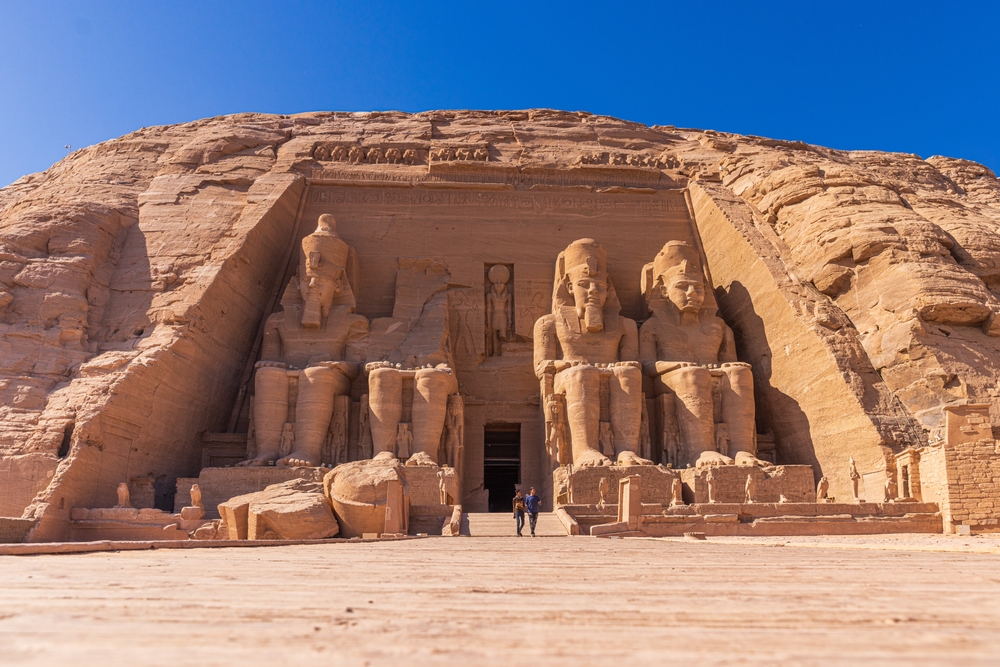
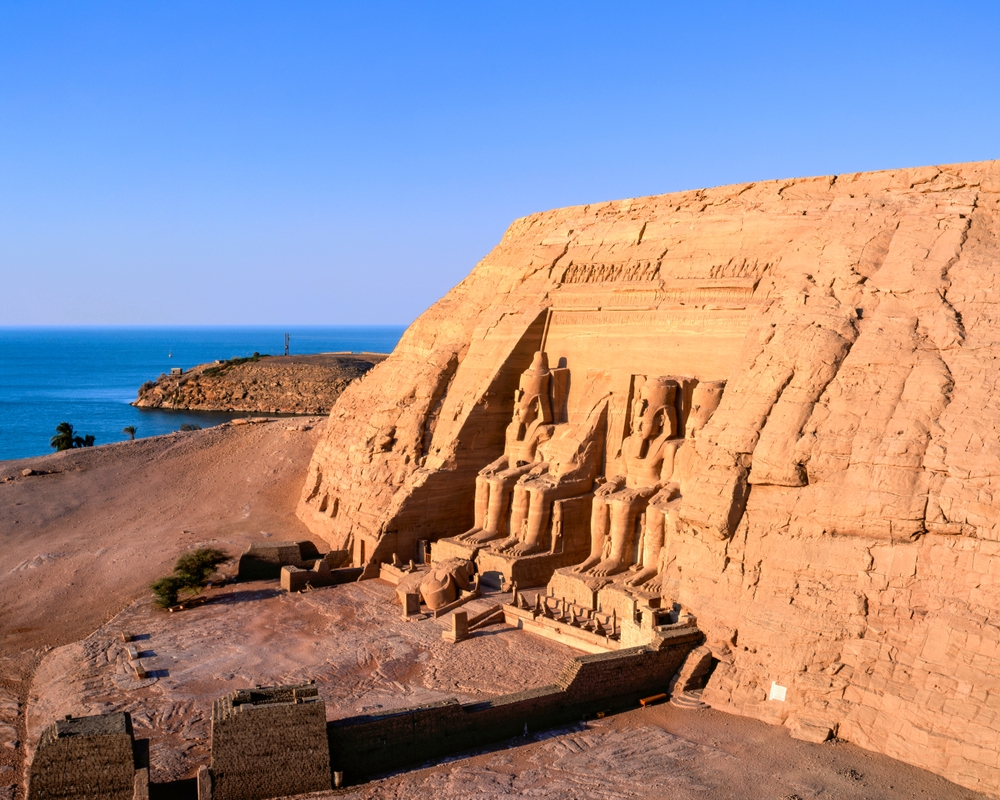
Deep in Egypt’s southernmost reaches, roughly 140 miles southwest of Aswan and barely a stone’s throw from the Sudanese border, sits one of the ancient world’s most fascinating architectural achievements. The temple of Abu Simbel rests on the western bank of Lake Nasser in Aswan Governorate, Upper Egypt, a location so remote it once required a multi-day Nile voyage to reach. Today, it draws hundreds of thousands of visitors each year.
The man behind Abu Simbel was Ramesses II — known to history as Ramesses the Great — who ruled Egypt during the 19th Dynasty, from around 1279 to 1213 BCE. One of antiquity’s longest-reigning and most prolific builders, Ramesses commissioned the complex around 1264 BCE, though scholars debate whether construction began closer to 1244 BCE. What is certain is that the project took roughly twenty years to complete.
The reasons for building here were both strategic and spiritual. The site lay at the second cataract of the Nile, on the ancient border between Lower and Upper Nubia — a region Egypt controlled but never fully subdued. Ramesses chose it deliberately: the temples were meant to announce Egyptian supremacy to anyone traveling the river, an unmistakable message carved directly into the sandstone cliffs. He also selected the location because it was already sacred to Hathor, goddess of love and motherhood, lending his construction project a divine endorsement.
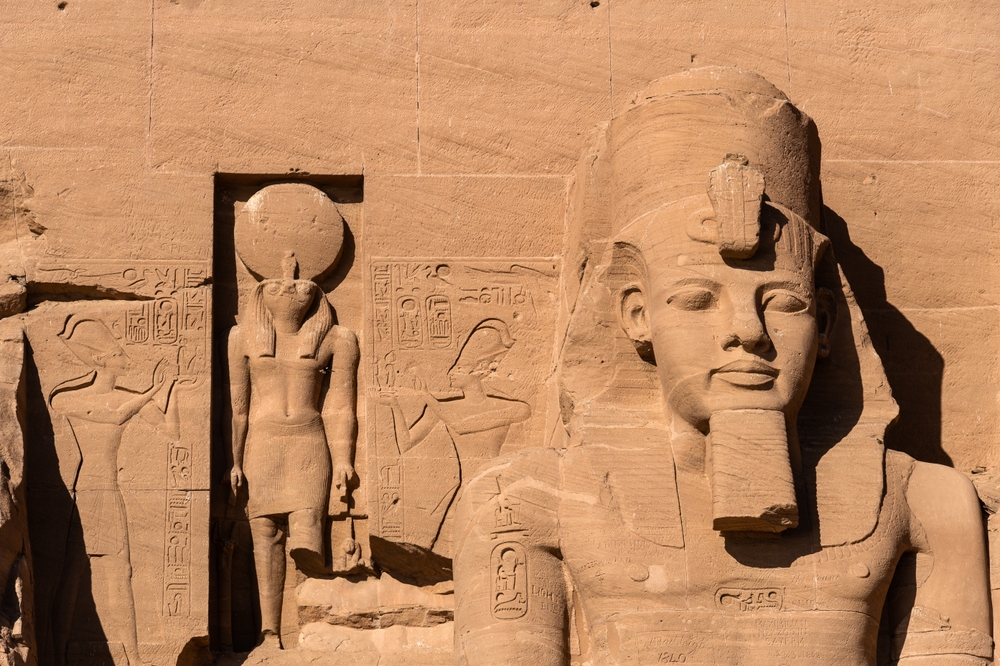
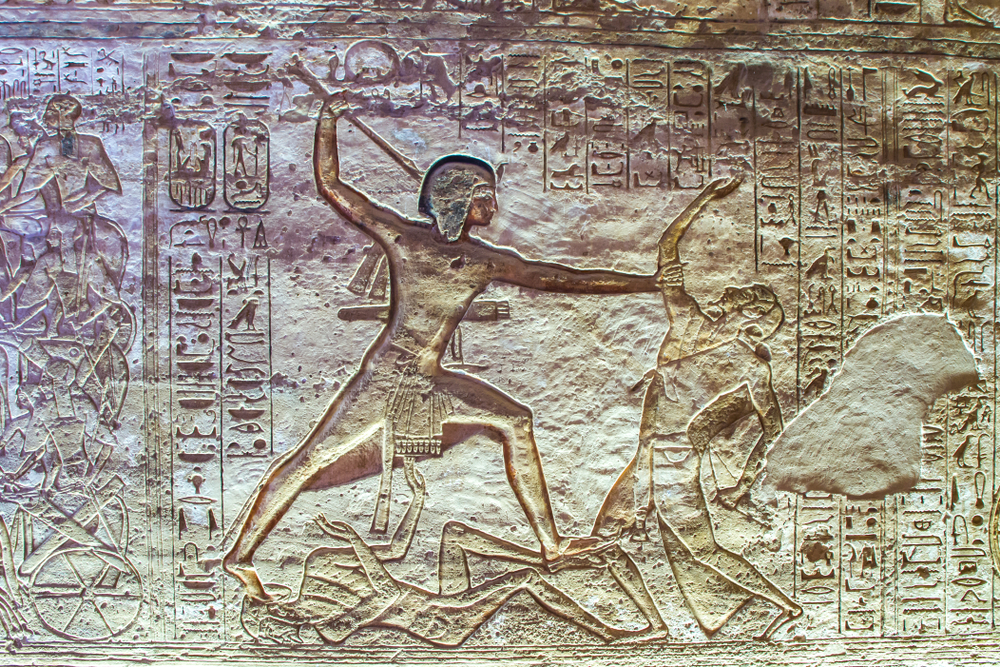
The Great Temple was dedicated to the sun gods Amun-Ra and Ra-Horakhty, to Ptah, and, in an act of self-promotion, to Ramesses himself. Featured are four colossal seated figures across its facade, each standing 65 feet tall and depicting the pharaoh enthroned. Flanking the entrance, carved around the giant’s feet in almost comically smaller scale, are figures of his wives, children, and mother. Inside, three consecutive halls extend 185 feet into the cliff, their walls covered with scenes glorifying Ramesses’ claimed victory over the Hittites at the Battle of Kadesh in 1274 BCE.
The smaller adjacent temple was dedicated to the goddess Hathor and to Ramesses’ wife, Queen Nefertari. In a remarkable gesture for an age when women were invariably depicted on a far smaller scale than their royal husbands, the facade of the Small Temple renders Nefertari the same height as Ramesses — a symbol of profound respect rarely granted to any Egyptian queen.
Perhaps the most astonishing aspect of Abu Simbel is not its scale, but its precision. The Great Temple was engineered so that on two specific days each year — February 22 and October 22 — the rising sun aligns perfectly with the temple’s axis, sending a shaft of light deep into the inner sanctuary to illuminate three of the four seated statues inside. Only the statue of Ptah, a god associated with the underworld, is left in permanent darkness.
These two dates are traditionally believed to correspond with Ramesses’ birthday and his coronation day, though no direct inscriptional evidence confirms this. What is not in doubt is that achieving this alignment — with tools unavailable to any modern surveyor standing in 1264 BCE — required astronomical knowledge and architectural precision that continues to humble modern engineers. Adding a further wrinkle: when the temples were relocated in the 1960s, the precise dates shifted by one day. The displacement of the structure and the accumulated drift of the Tropic of Cancer over three thousand years means the light now enters on February 21 and October 21.
For more than a thousand years, the temples were swallowed by the desert. By the early 19th century, sand had drifted so high that only the tops of the great colossi remained visible. The Swiss explorer Johann Ludwig Burckhardt came upon the partially buried site in 1813, reportedly guided to it by a local Egyptian boy named Abu Simbel — and the complex has borne that name ever since. Burckhardt was unable to excavate what he found, but mentioned the site to his friend, the Italian adventurer Giovanni Belzoni. In 1817, Belzoni returned and successfully cleared enough sand to enter the Great Temple, though his methods were more those of a treasure hunter than an archaeologist.
In 1959, a threat emerged. Egypt’s construction of the Aswan High Dam would create a vast reservoir, Lake Nasser, that would swallow Abu Simbel entirely. Egypt and Sudan appealed to UNESCO, which launched one of history’s most ambitious preservation efforts.
Beginning in 1963, workers using wire saws methodically sliced both temples into more than a thousand blocks, some weighing up to 30 tons. Each block was numbered, transported to temporary storage, and then painstakingly reassembled within a purpose-built artificial cliff 200 feet higher and 600 feet inland from the original site. The entire operation cost $80 million — half donated by 50 countries — and was completed on September 22, 1968. It remains one of the most complex and successful archaeological salvage operations ever undertaken.
Modern visitors have several practical options for visiting the site. The most common approach is by road from Aswan, approximately a three-hour drive south through the desert, with many travelers joining organized day trips that depart in the early hours to reach the temples at dawn, when the light is golden and the crowds thinner. For those who prefer to fly, Abu Simbel Airport, a small airfield built in the 1970s specifically to serve the site, offers year-round connections to Aswan International Airport and limited seasonal flights to Cairo. A more atmospheric, if lengthier, option is a Lake Nasser cruise, gliding across the reservoir to arrive at the temples by water, much as ancient travelers once did.