


For decades, luxury safari sold access: dawn game drives, leopard sightings in marula trees, sundowners against a burning horizon. Now, for a certain kind of traveler, access means something else entirely. It means paying not simply to see wildlife — but to help keep it alive.
Across parts of South Africa, a new form of ultra-premium conservation tourism is emerging in which guests contribute substantial sums — often around US$15,000 on top of the cost of their safari — to fund live rhino dehorning operations in full: helicopter, pilot, wildlife veterinarian, veterinary drugs, armed security teams, trackers, vehicles and ground crew required to carry out the procedure safely.
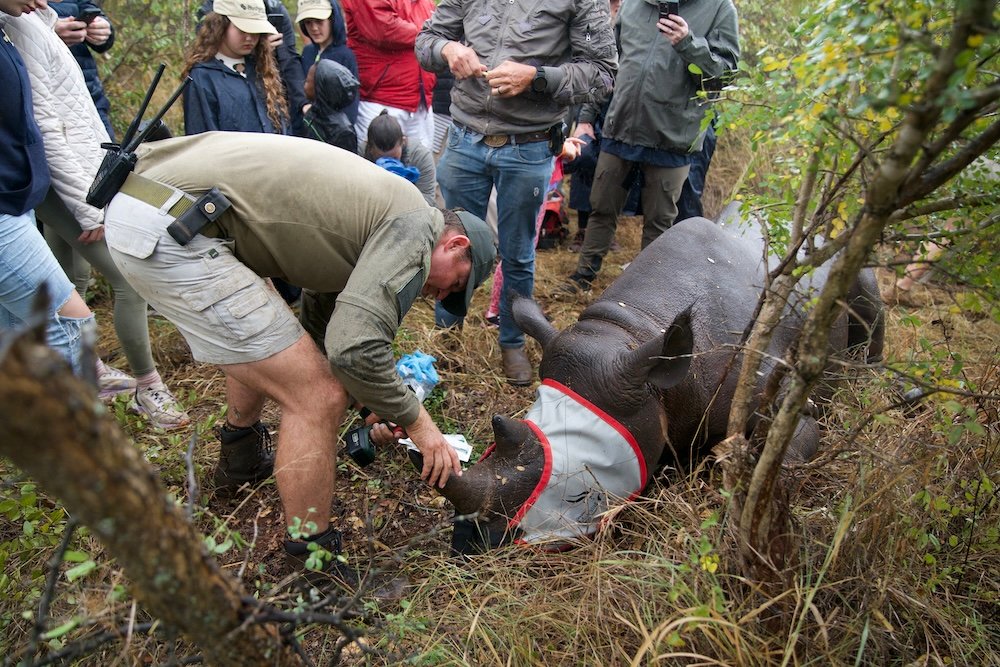
It is not a symbolic donation or token add-on. It is direct underwriting of frontline wildlife protection, and when the day comes, these guests witness exactly what their money has paid for.
The radio crackles before the helicopter is even in sight. “Visual confirmed. Moving south-east. Two hundred metres from the tree line.”

On the ground, rangers have already been tracking the rhino for hours, moving quietly through the bush and relaying coordinates to the pilot and veterinarian waiting nearby. When the call comes in, the helicopter lifts almost immediately.
The rhino breaks from cover fast, running hard across open ground as the aircraft drops lower and tracks her line. From above, the pilot guides her carefully toward a clearing where the team can work safely. The veterinarian leans out, steadies the dart rifle, and fires.
The dart lands cleanly. For a few moments, nothing changes. Then her stride shortens. Her head dips. On the ground, the team waits for the exact moment the sedative takes hold.
When it does, everything accelerates.
Vehicles move in. Rangers jump out before the wheels have fully stopped. One sprays water over her body to keep her cool. Another covers her eyes and ears to reduce stress. Others position her head and legs so she can breathe properly. Nearby, armed guards form a perimeter while the helicopter circles overhead.

The chainsaw is brought forward.
The sound is abrupt — mechanical, jarring — followed by the smell of burnt keratin in the heat. The veterinarian monitors every breath. No one wastes a second. The horn is freed, passed back immediately, and antiseptic is applied. Measurements are taken. The reversal drug is administered.
Minutes later, the rhino stirs, rises heavily to her feet, and disappears back into the bush. Alive.
 In parts of southern Africa, this is no longer exceptional. Dehorning has become routine across a growing number of private reserves — not because it solves poaching, but because it reduces the incentive to kill. Horn can fetch huge sums on the black market. Remove the horn, and in many cases, you remove the primary reason to target the animal.
It is not a permanent solution. Rhino horn regrows, meaning the procedure must be repeated every 12 to 24 months. Behavioral impacts remain debated. Yet many reserve owners and conservation managers see the equation starkly: imperfect intervention, or dead rhino.
The economics behind that decision are reshaping safari tourism.
Protecting rhinos is expensive. Anti-poaching units, intelligence networks, fencing, surveillance systems, aerial patrols, veterinary teams and rapid-response capability all carry escalating costs. For private reserves managing vast tracts of land, conservation is a permanent financial pressure.
Increasingly, high-end tourism is helping fill the gap.
A small but growing number of reserves now invite guests to fund rhino protection directly — and, in select cases, to attend dehorning operations as part of a conservation-led safari. These are highly exclusive experiences aimed at affluent travelers who want measurable impact rather than passive philanthropy.
For reserves, the logic is practical. Dehorning is happening regardless. If a guest funds the operation, core revenue can be redirected into habitat management, ranger salaries, intelligence gathering and broader species protection.
For the travel industry, that shift matters. Luxury clients are increasingly asking where their money goes. Sightings alone are no longer enough. Many now want access, purpose and evidence that their spend supports something tangible.
Rhino dehorning experiences sit directly within that trend. They are not mass-market products, nor suitable for every client. But for engaged, conservation-minded travelers willing to pay for rare access and real-world impact, they offer one of the most powerful wildlife experiences on the continent.
The model is not without controversy. Critics argue that bringing paying guests into a stressful and invasive procedure risks commodifying conservation. Others question whether such intimate access blurs ethical boundaries between protection and spectacle.
Reserve managers tend to answer bluntly: the procedure would take place whether tourists were present or not. Tourism is not creating the intervention. It is funding it. That distinction matters at a time when conservation funding is under strain. In some reserves, guest contributions are now underwriting a meaningful share of frontline rhino protection.
At the same time, anti-poaching strategies are becoming more sophisticated. Many operations now combine ground patrols with aerial surveillance, drones and intelligence-led enforcement. Further down the supply chain, initiatives such as the Rhisotope Project are testing traceable isotopes inside horn to help detect smuggling at borders.
Together, these efforts reflect a new reality: rhino conservation is no longer a single-solution problem. It is a layered system of interventions, each tackling a different point of threat. Dehorning remains one of the most visible — and most contested.
The rhino disappears back into the bush, the landscape closing around her as if nothing has happened.
But something has. She will live — because of intervention. Because of money. Because travelers chose to fund a helicopter, a dart gun, a veterinarian and a security cordon in the African dust. For safari, that is a profound shift. The old model sold observation. The new one sells responsibility.
And for the travel industry, the question is no longer simply where to send clients. It is how close they want to bring them to the real cost of keeping wildlife alive.
Bushwise Exclusive Experience is a specialist safari for travelers seeking more than a conventional lodge stay. It offers a live-in bush immersion with expert guides, deeper wildlife access and a strong conservation focus.
Based in Greater Kruger, guests stay in intimate camps or private lodges while experiencing the daily rhythm of the bush. Activities include animal tracking, spoor reading, bird and plant identification, guide techniques and first-hand conservation insight from field professionals.
Pricing reflects the specialist nature of the experience: expert guiding, small groups, privileged access and hands-on learning. Ideal for travelers seeking authenticity, wildlife knowledge and a deeper connection to the African bush.