

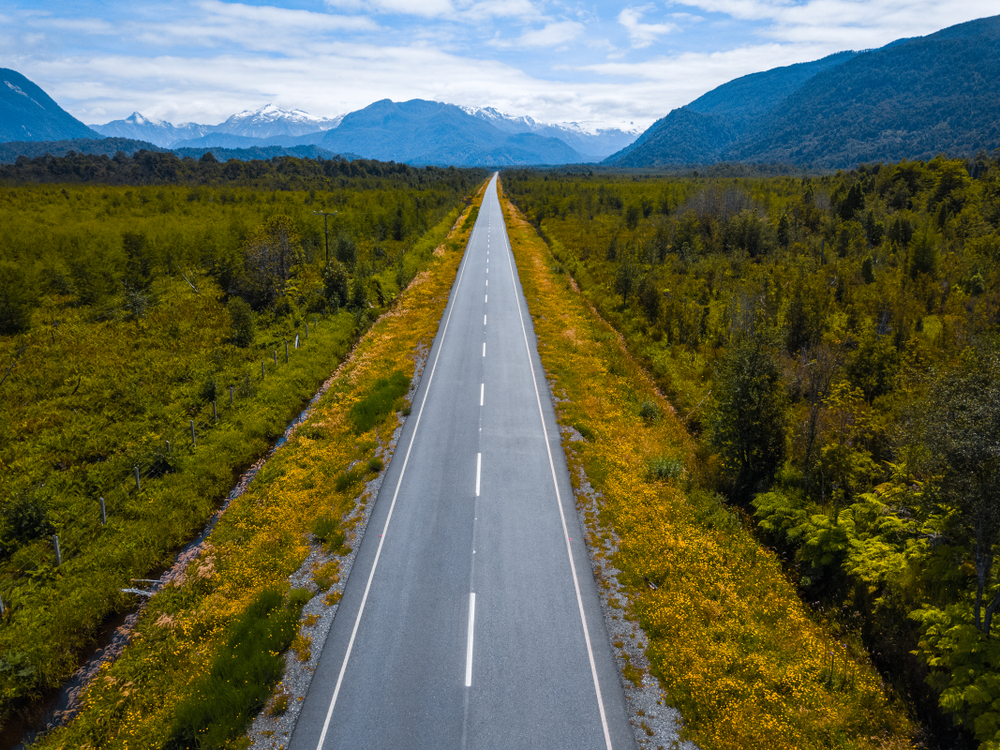
There’s a road that runs for 770 miles down the centre of Chile, taking its travellers through forests, national parks, spectacular soaring mountains and turquoise lakes. It’s a route of legends and heroes, superhuman effort and isolation, and one of the most beautiful routes in the world. It’s also one of the few remaining trips that still deliver that rare sense of achievement when you actually accomplish it.
The Carretera Austral (southern highway) rolls through untamed scenery in the greenest and narrowest part of Chile. But this is no Route 66, to be tackled at speed in a sexy sports car. Although 770 miles sounds easy, the roads are often narrow gravel lanes sweeping around sharp mountain bends. It’s a trip that demands a slow speed and a cautious attitude. Since the route also crosses three lakes, the whims of car ferry agendas must also be factored in. Tourism has barely touched this area. Maybe in a few years Starbucks will arrive, but right now the facilities are small and simple hotels, family-run restaurants, and boat trips offered by fishermen turned tour guides. It’s all delightfully local and authentic.

The route begins in Puerto Montt, a historic town roughly two-thirds of the way down Chile’s extraordinary length. It finally peters out in Villa O’Higgins, which is still only three-quarters of the way down, but further progress is scuppered by the massive Southern Patagonian Ice Field.
The Carretera is so long that it would be daft to tackle it all in one trip. Handily, it’s divided into northern and southern sections, with an airport at the town of Balmeceda in the middle. I chose the southern route specifically to see the Marble Caves, a spectacular natural phenomenon where cliffs around General Carrera Lake have been sculpted by water erosion. A 90-minute boat trip from the town of Puerto Río Tranquilo was magical, as we navigated around brilliant blue and white arches reflected back in the clear lake. It’s other-worldly and utterly beautiful.

Continuing south, you soon reach a viewpoint for the confluence of two rivers, Rio Baker and Rio Neff, with a small waterfall and rocky outcrops where you can splash in icy water flowing down from the glaciers. Another highlight is the excellent museum in Patagonia National Park, established by the wealthy US conservationist Douglas Tompkins. The touchy-feely museum is a challenge to human complacency, delivering a strong message about over-population, the abuse of resources, and the need to reconnect with nature. Most disturbing is a display showing dozens of species of animals and birds. As you move a lever from the past to the present, the lights behind each species go out as they became extinct. Push the lever into the near future, and the bleak prognosis shows how many more species human behaviour will exterminate.

Back on the road, the town of Cochrane is a good base to spend a night or three, with a choice of hotels and restaurants. A great day trip from here is to Caleta Tortel, a unique village built on the slopes of a hill tumbling down to a bay. The settlement began in 1955 as a logging centre and there are no roads, just cypress-wood paths and steep staircases between wooden houses built on stilts up and down the hillside. From here we took a boat trip to Jorge Montt Glacier. This is an area of countless inlets and islands on the ragged Pacific coastline, with a backdrop of glacier-capped mountains. Eventually we began passing icebergs, and our captain dodged around increasingly large clusters of icebergs until we reached the solid mass of the glacier itself.

A day later, after passing more mountains, lakes, rivers and glaciers, we finally boarded another ferry across a fjord and onto Villa O’Higgins, the last settlement along the Carretera. It’s a nondescript community of about 600 people, with a tiny museum and church dedicated to a pioneering pastor, Padre Antonio Ronchi. There’s also the smallest tourist office I’ve ever seen, and I couldn’t help asking the friendly assistant why this beautiful but desolate region is inhabited at all. He told me that during some border disputes with Argentina, the government persuaded Chileans to occupy this almost uninhabitable place by giving large plots of land to those willing to accept the challenge.
In fact the whole Carretera project was driven by the twins need of staking Chile’s claim to the land and connecting its far-flung communities. The massive undertaking is still viewed with national pride, representing the perseverance to overcome near-impenetrable landscapes and extreme weather conditions by the 10,000 army conscripts who constructed it.
It’s now a route of conservation rather than colonisation, aiding efforts to preserve and protect these wild and pristine territories. Even today Villa O’Higgins is still very basic – the largest supermarket has no medical supplies and there’s no pharmacy either. Isolation indeed.
The harsh weather – and the lack of people – meant that the route originally ended further north in Puerto Yungay. But a final 61-mile stretch was opened in the year 2000, culminating at an official “End of the Carretera Austral” sign by San Martin Lake.
The journey there is rewarded by fantastic views across the lake to Argentina, beside the iconic sign announcing that you have literally reached the end of the road.
So is it worth it? Yes, definitely – but with a caveat: hire a car and go it alone. I took an organised coach trip with a reputable company, but it turned this magnificent journey into a 7-day endurance test. It felt like the journey was designed with a map and unrealistic expectations, not by a local who knows the distances and the conditions. Thirty people all queuing for the toilet turned every pitstop into an hour-long bore, leaving too little time to enjoy the museums and parks or to explore the quaint towns on our own.
So, here’s how to do it properly:
Pick your season: Patagonian weather is notoriously challenging. I was lucky that my trip coincided with hours of sunshine and very little wind. In general, the northern section is rainier, while the south is colder and windier. Summer from December to March is perfect, with the best weather and the ferries, lodges and restaurants fully operational. Spring and autumn are less busy, with nature waking up with colourful wild flowers or going to sleep with fiery reds and golds. But the weather is less stable and some businesses may be closed. Winter is a no-go zone, with heavy snow closing some mountain passes and black ice making the road deadly.
Pick your vehicle: The road is manageable in a regular high clearance vehicle, although a 4×4 feels more appropriate. A lot of bikers conquer it too, with their dust-caked motorbikes reflecting the gritty nature of the venture. Spare tyres are essential, and spare fuel too, in case you forget to fill up at the last tiny outpost. Don’t even think of driving at night, since the road is curvy and narrow in places, and wild animals may be crossing.
Take it slowly: Don’t aim to cover too much distance in a day. Progress can be slowed by roadworks, occasional landslides, or queues for a ferry. Slow down and enjoy the Patagonian landscape. Stop to drink in the spectacular views, and chat to the locals serving you a delicious slice of cake or the juice of some unknown berries. Dip your feet in a freezing stream. Take a kayak trip or a guided hike. Stroll around isolated villages and imagine what it would be like to live there. Walk across the bridges and wonder how people ever managed to build such infrastructure amid such wilderness. Then take that photo that proves you’ve lived the Carretera Austral.