

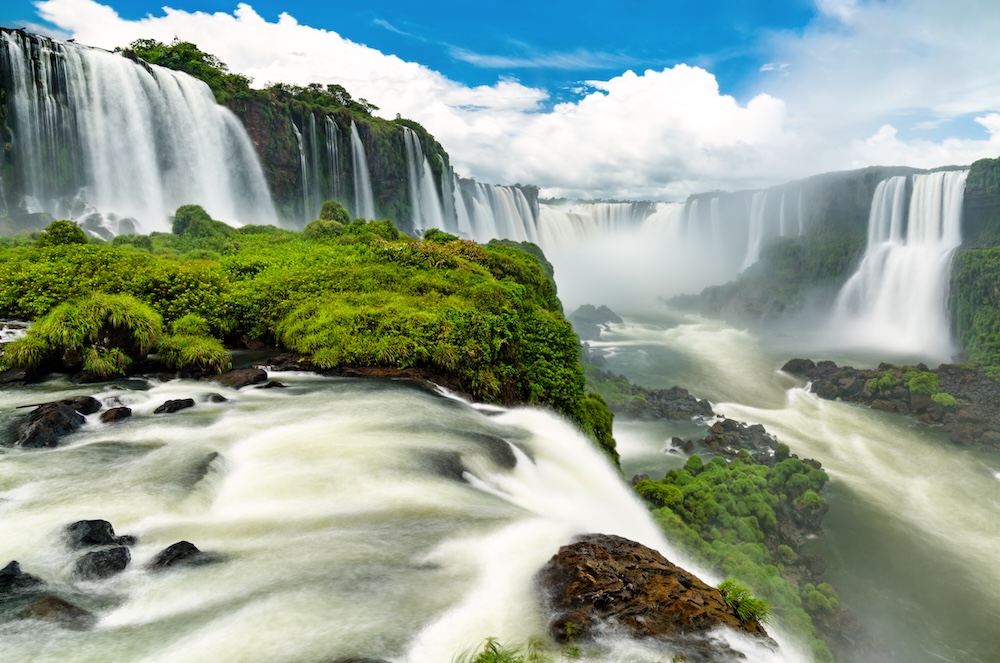
At the Devil’s Throat, on the Argentine side of Iguazu Falls, the mist arrives before the sound, and the sound arrives before the sight. You walk a kilometer of steel catwalk over a river so flat and unbothered it seems to be lying to you, and then the walkway simply ends at a railing above a horseshoe of water eighty meters deep, into which fourteen separate cataracts empty at once. Nobody finishes their sentence at that railing. I have watched grown adults, mid-conversation, just stop, mouths still open, and I don’t think it’s the view. I think it’s the fact that water this loud rearranges what your brain is doing with its attention, whether you asked it to or not.
That rearrangement is the real subject of any honest waterfall story, and it’s worth understanding before touring the highlight reel. Falling water shears air molecules apart in a way still water doesn’t, releasing negative ions in concentrations that indoor air rarely matches; there’s real, if modest, research suggesting this correlates with a measurable lift in mood, the same effect people chase in salt caves and after thunderstorms. Psychologists studying attention have long noted that certain natural scenes — water chief among them — produce what they call “soft fascination,” enough visual interest to occupy the mind without demanding effort, which is why staring at a waterfall feels like rest rather than stimulation, the mental equivalent of a shoulder finally unclenching. Researchers point to something more basic: falling water is vast, unpredictable in its particulars even while constant in its whole, and forces a small, pleasurable recalibration of scale, the same mechanism that makes cathedrals and canyons feel larger than their measurements. You feel it standing at a railing. You rarely think about why, and the not-thinking is arguably the point.
Iguazu delivers that recalibration twice, because the two national parks — Argentina’s and Brazil’s — offer opposite arguments about how to see the same river. Argentina puts you inside the falls, on catwalks threading between individual cascades, close enough to be soaked and deafened. Brazil, across the border, keeps its distance and gives you the panorama: nearly the entire 2.7-kilometer curtain visible from a single trail, which is the version that actually looks like a postcard, if postcards could shake.
Victoria Falls, on the Zambia–Zimbabwe border, works by a different mechanism entirely: width rather than enclosure. At just over a mile across and more than 100 meters tall, it is neither the tallest nor the widest waterfall on earth, but no other waterfall claims to be both at that scale, which is why locals call it Mosi-oa-Tunya, “the smoke that thunders,” a name David Livingstone heard in 1855 and, with the confidence of a man about to rename something that already had a perfectly good name, ignored. The Zimbabwean side gives you the classic view, rainforest-soaked and often obscured by its own spray. The Zambian side gets you closer to the edge, literally, at the Knife Edge Bridge, and in the low-water months of September and October, brave or foolish visitors swim to the lip of the falls itself in a natural rock pool called Devil’s Pool, a piece of geology that exists specifically to let you look straight down a hundred-meter drop while a guide holds your ankle. The dry season strips away the mist and lets you see the full drop; the wet season buries the view in spray so total you can feel it from a mile off and see almost nothing at all. Visitors tend to prefer whichever version they didn’t get.
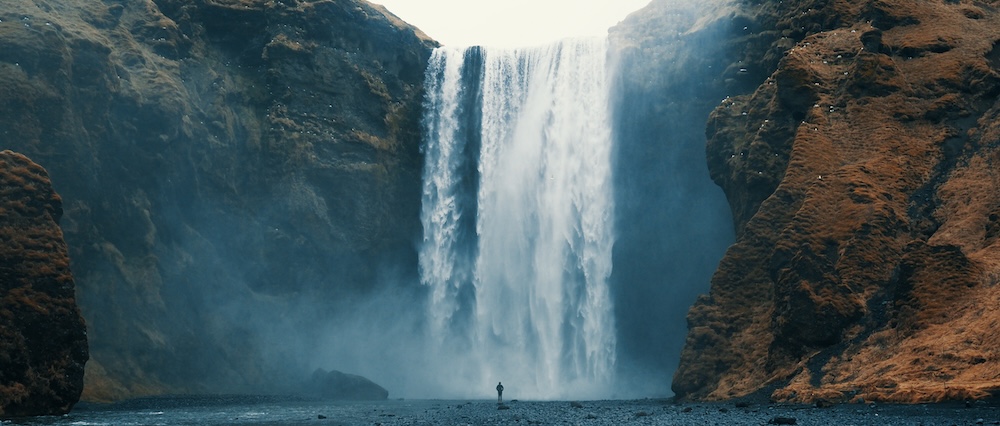
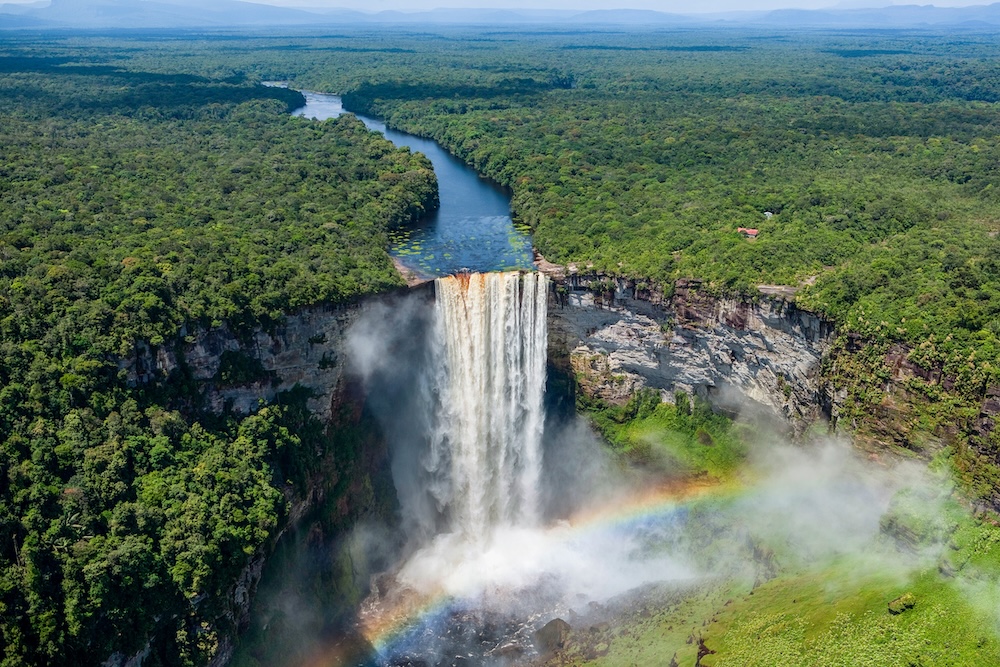
Kaieteur Falls, in the Guyanese interior, offers the opposite of both: solitude. There’s no cable car, no boardwalk crowd, no souvenir stand — you fly in on a small plane or hike for days through rainforest to stand at the edge of a single, uninterrupted 226-meter drop, nearly five times the height of Niagara, on a plateau with almost no railing between you and the Potaro River’s decision to stop being a river. Few people ever see it, maybe a few dozen visitors on a given day, scattered thin enough that you can hear individual birds over the roar if you’re patient. That scarcity is its own kind of amplifier; awe compounds when there’s no one else’s reaction to compare yours against, no crowd murmur to fold your own response into. You’re left alone with the noise and have to decide for yourself what to do with it.
Which nation has the most waterfalls? The question depends on the way one asks it, but here are a few notable entries:
- Japan: With an astonishing 162,622 documented falls, its steep, volcanic landscapes make it the global leader in total waterfall count. Notable examples include the twin Shomyo and Hannoki Falls.
- United States: Home to over 17,000 recorded waterfalls. The state of Washington alone boasts nearly 3,000 of them, followed closely by Oregon and California.
- Norway: Renowned for having the highest concentration of tall waterfalls in Europe, including 10 of the world’s 30 tallest. Melting glaciers and steep fjords feed thousands of cascades like Vinnufossen.
- Sri Lanka: Holds the world record for the highest density of waterfalls relative to its land size, cramming over 400 to 500 recorded waterfalls into one small island nation.
None of this requires the tallest, widest, or most-photographed waterfall on the list. A roadside cascade in the Blue Ridge Mountains, ten feet of drop over granite, does a smaller version of the same trick to a driver who pulls over on a whim. Scale changes the intensity, not the mechanism. What stays with you isn’t the statistic — the meters, the cubic feet per second, the rankings that guidebooks like to argue over. It’s standing at a railing, mid-sentence, having forgotten what you were about to say.