




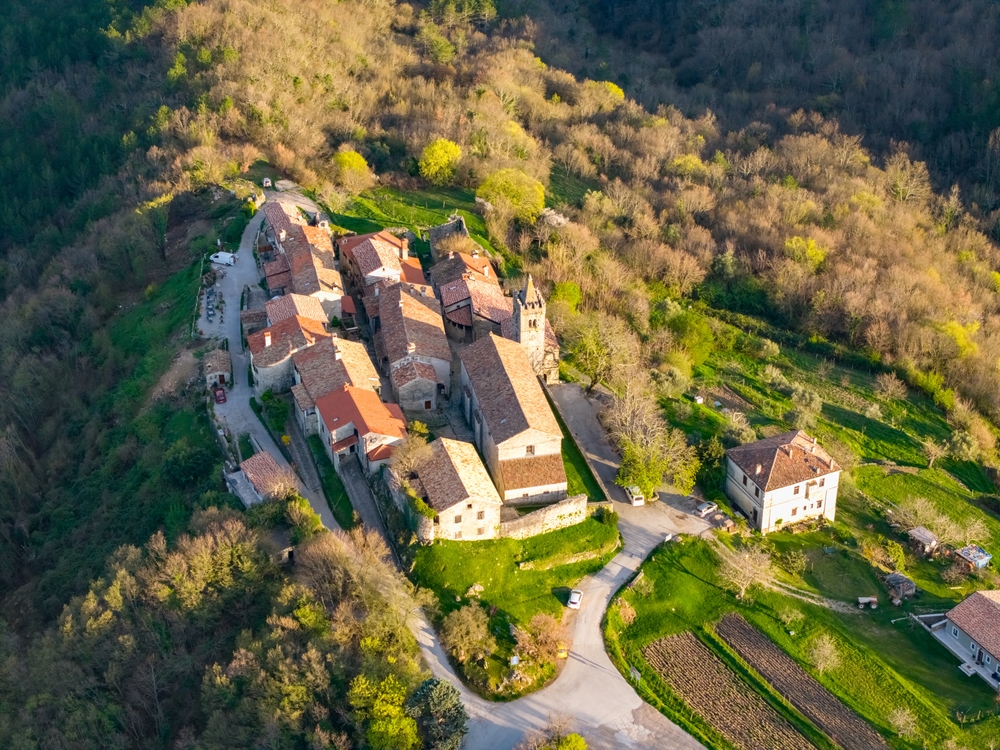
How would you “measure” a city many believe to be the world’s smallest? Population? Surface area? While the metrics for the distinction are open to debate, the fact is that sitting quietly in the hills of Croatia’s Istrian Peninsula is the village of Hum, widely regarded as the smallest town in the world. With a population that rarely exceeds two dozen residents, Hum is less a bustling destination and more a living artifact that rewards travelers who value history, atmosphere, and the pleasure of discovering places that time has overlooked.
Hum’s origins date back to the 11th century, when it emerged as a fortified settlement atop a hill overlooking the surrounding valleys. Encircled by stone walls and entered through a single gate, the village retains its compact medieval layout, unchanged for nearly a thousand years. Stepping inside feels like crossing into another era. Cobbled lanes wind between stout stone houses, and nearly every building carries architectural details that speak to Romanesque and early medieval craftsmanship.

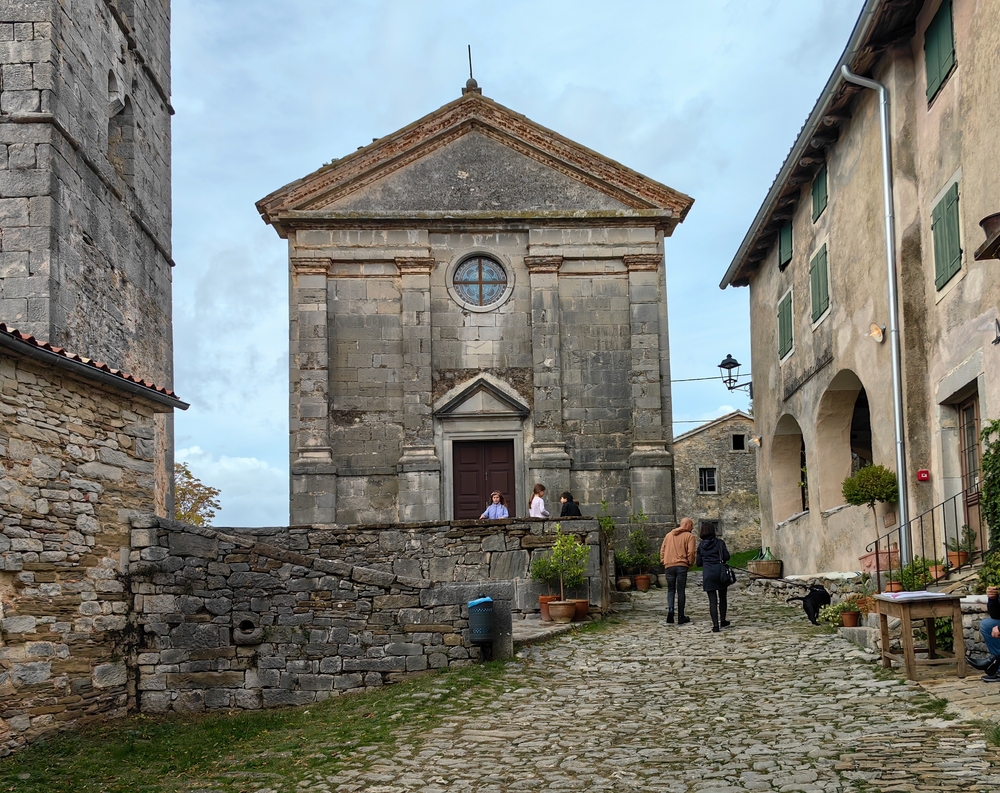
At the heart of Hum stands the Church of the Assumption of Mary, whose simple exterior gives little hint of the cultural importance contained within. Nearby, the 12th-century Church of St. Jerome features frescoes and inscriptions tied to the Glagolitic script—an ancient Slavic alphabet that holds deep significance in Croatian cultural history. Hum and its surrounding region played an important role in preserving this script, making the village a quiet but meaningful landmark in the story of Slavic literacy. In fact, one of the most distinctive features connecting Hum to its past is the Glagolitic Alley, a sculptural pathway linking Hum with the nearby town of Roč. Along this route, stone monuments commemorate the development of the Glagolitic alphabet and honor the scholars who preserved it.
Despite its size, Hum maintains traditions that reinforce its sense of continuity. Each year, villagers participate in a ceremonial election known as “župan izbor,” where the town’s mayor is chosen using carved wooden tally sticks—a practice rooted in medieval customs. This ritual underscores a broader truth about Hum as a place where its history and traditional heritage is actively lived.
Culinary pleasures also play a surprising role in Hum’s appeal. The village is known for its connection to Istrian gastronomy, particularly truffles and local brandies. One of the most famous is biska, a mistletoe-based rakija flavored with herbs and spices according to age-old recipes. Sampling it in Hum, surrounded by stone walls and sweeping countryside views, feels less like a tasting and more like a rite of passage. Although mistletoe is poisonous when eaten raw, biska is an example of empirical folk chemistry, made using a centuries-old process in which only specific parts of European mistletoe are fully macerated in high-proof alcohol, a method that neutralizes harmful compounds and removes all plant material before consumption. The finished spirit is produced by experienced makers, consumed in small digestif quantities, and is considered safe when prepared according to traditional standards in Hum and across Istria.


The setting itself is integral to Hum’s charm. Rolling hills, vineyards, and forests define the surrounding landscape, making the village an ideal stop for travelers exploring inland Istria. Unlike the sun-drenched Adriatic coast, this region offers a quieter, more introspective version of Croatia—one marked by pastoral beauty, slow rhythms, and a strong connection to land and tradition.
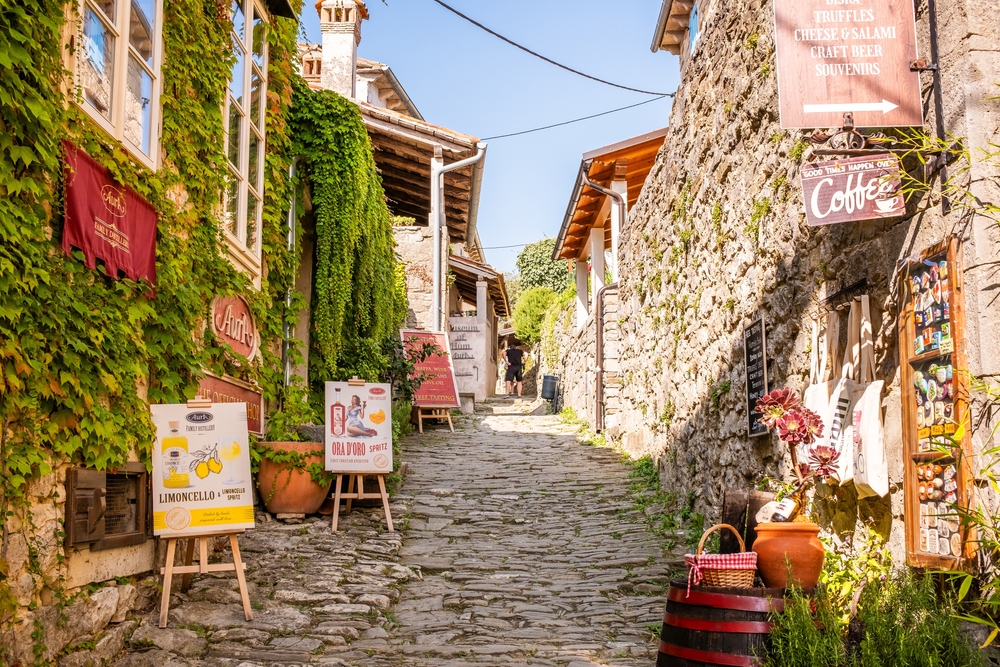
Hum is not a destination for those seeking nightlife, shopping districts, or long lists of attractions. Its magic lies in stillness: the sound of footsteps on stone, the scent of wild herbs in the air, the sense of standing somewhere profoundly human in scale. A visit may last only an hour or two, but the impression endures far longer.
In a world increasingly defined by scale and speed, Hum offers a gentle counterpoint. It reminds travelers that significance is not measured in size, and that some of the most meaningful journeys lead not to grand capitals or famous landmarks, but to small places where history, culture, and landscape exist in rare and harmonious balance.