This year, South African Tourism is celebrating 100 years since the establishment of Kruger National Park. Kruger is one of the world’s great treasures, helping to preserve and protect some of Africa’s incomparable wildlife. Kruger makes the wildlife experience accessible to all.
I tend to agree with Ken Burns and Dayton Duncan’s assertion in their film and book on the National Parks that they were “America’s Best Idea”. One of the best, anyway.
The idea was to set aside and protect special lands for the enjoyment of not just royalty or the rich few, but for all the people. It was the ideal of democracy expressed in the land itself, preserving great natural treasures for all the people. The idea started in America, growing out of conservation movements of the 19th century. But, like the idea of democracy itself, it spread all over the world.
Yellowstone is considered the first national park in the world, established on March 1, 1872, when President Ulysses S. Grant signed the Yellowstone National Park Protection Act. But there was an earlier precedent that goes back to the great Abraham Lincoln himself.
It was during the American Civil War, June 30, 1864, that Lincoln signed the Yosemite Grant Act, which set aside California’s Yosemite Valley and the Mariposa Big Tree Grove “for public use, resort, and recreation.”
Under that act, Yosemite was under the jurisdiction of California. It did not become a national park till 1890 when Congress reclaimed the area and later incorporated the Yosemite Valley itself into the national park. So, Yosemite has a legitimate claim to being the first area set aside and preserved for regular people.
There had been protected wilderness areas before. Bogd Khan Uul, in modern-day Mongolia, was set aside as a sacred, protected area in 1778. Białowieża Forest in Poland was set aside for royal hunting in the 1500s. Britain set aside areas for royal hunting as far back as the 1100s. What was different about the national park idea, was that it was for all citizens, not just the elite.
The idea spread around the world. Australia’s Royal National Park was established in New South Wales in 1879. Canada’s Rocky Mountains Park, later Banff National Park, was set aside in 1885. New Zealand’s Tongariro National was established in 1894. Now there are more than 6,000 national parks all over the world.


A Century of Wilderness Protection
South Africa’s Kruger National Park goes way back. Though it became a National Park in 1926, it was originally set aside as a protected area in 1898 by then-President Paul Kruger, who was already at that time concerned with Africa’s vanishing wilderness and wildlife. It was called The Sabie Game Reserve and it was set aside to protect those areas. It was not designated for public use.
The game reserve was expanded during the period 1902-1906, but did not become a national park until 1926. It was established by the National Parks Act of 1926 for the purposes of wildlife preservation, scientific study, and public recreation and tourism.
By 1926 it had already been a protected area for more than 20 years, so it’s quite pristine today, having been protected for more than 120 years.
One of the World’s Largest Protected Areas
Kruger is a phenomenal piece of land. At 7,576 square miles in area, it’s almost the size of New Jersey. Kruger is 217 miles long from north to south and 37.2 miles wide from east to west. It’s larger than all 63 of the U.S. National Parks except three in Alaska: Wrangell at 20,587 square miles, Gates of the Arctic at 13,238 square miles, and Denali at 9,492 square miles.
The wilderness area is actually even larger if you count the protected areas in Zimbabwe and Mozambique that are contiguous with Kruger, though separated by national borders.
In 2002, the Great Limpopo Transfrontier Park was established, incorporating the Kruger National Park in South Africa, the Gonarezhou National Park in Zimbabwe (1,951 square miles) and the Limpopo National Park in Mozambique (3,861), comprising a total land area of some 13,388 square miles. That is larger than all the U.S. National Parks except Wrangell.
Wilderness Accommodation
Kruger has 25 official camps and lodges run by South Africa National Parks, the government agency in charge of the national parks, plus six luxury concession lodges, for a total of 31 accommodation options inside the park.
The companies operating the luxury camps and lodges include: Singita Lebombo, Singita Sweni, Lukimbi Safari Lodge, Jock Safari Lodge, Imbali Safari Lodge and Hamiltons Tented Camp.
The greater wilderness area of Kruger actually extends even farther than stated above because there are several private wilderness reserves that border on Kruger. Even though they are private and separated from Kruger by fencing, they do expand the protected wilderness even farther. They are set aside for both tourism and conservation and the safari camps on them can be booked and enjoyed by tourists.
There are seven private game reserves contiguous with Kruger. They add nearly 800 square miles of protected wilderness. They are: Sabi Sand Game Reserve, Timbavati Private Nature Reserve, Klaserie Private Nature Reserve, Balule Nature Reserve, Umbabat Private Nature Reserve, Thornybush Game Reserve and Manyeleti Game Reserve. They each provide an exclusive safari experience with their own unique style of rustic luxury.
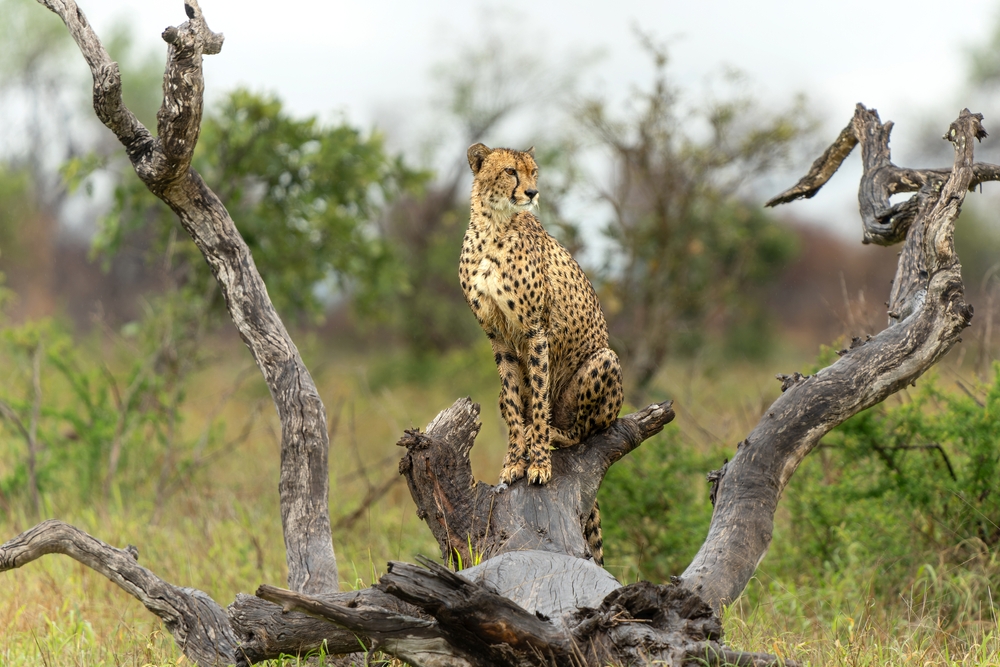
Kruger definitely offers the Big Five, which are lion, leopard, elephant, rhino and buffalo, as well as many other spectacular species, such as giraffes, elephants, zebras, wildebeests, impala, kudu, elands, baboons, cheetahs, hippos, hyenas, vervet monkeys, warthogs, wild dogs and much more. There can be no doubt that Africa has the greatest, most charismatic wildlife in the world, and Kruger has pretty much all of it.

Sianda – South Africa’s AI Travel Assistant
In other South African Tourism news, the agency has launched Sianda, its new AI travel assistant, which can be used by travel advisors as well as clients.
It provides instant answers to questions about safaris, hiking, restaurants, cultural experiences and whatever else clients are interested in experiencing in South Africa. Sianda can be found at https://www.southafrica.net/us/en/travel.
Sianda was built on Matador’s award-winning GuideGeek platform. It will provide answers to questions as well as built-to-order itineraries, real-time recommendations using data from South African Tourism and more than 1,000 integrations. Travel advisors can use it to research the destination, craft tailored experiences, and support clients.
The name Sianda comes from isiXhosa—one of South Africa’s 11 official languages—and means “We are growing.” There seems to be some hidden meaning there …
Certainly South Africa’s tourism business is growing. In 2024, the United States continued its reign as South Africa’s number one overseas source market, up 5.2% year-over-year. Canada beat that with 5.5% growth. In 2025, in spite of much turmoil in tourism markets, the momentum of North American travel to South Africa continued. From January through October, U.S. arrivals increased by 7.5%. Canada, with its tourism market to the U.S. now dried up, increased its tourism to South Africa by 15.2%.
Plane fares from New York to Johannesburg today start at $778. And once you arrive, your money is worth much more than it is here in the states.
For more information on travel to South Africa, see South African Tourism.