




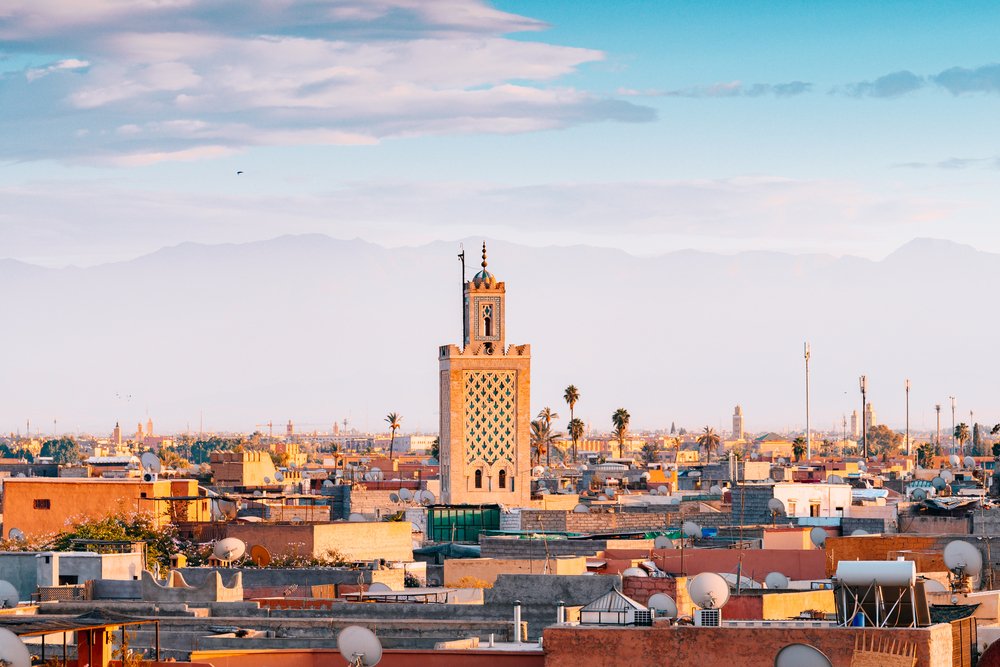
Marrakech is a city where streets are alive with the vitality of markets and colors that enhance the atmosphere in this walled city. It sits at the foot of the High Atlas Mountains with a natural beauty that could never be overshadowed by the rising peaks above it. An imperial city settled in the 11th century, the Red City stands as an anchor to the past and a crossroads for ancient trans-Saharan trade routes.
A Brief History
With a population of about 1 million, Marrakech is the most-visited and cosmopolitan destination in Morocco. Its origins were one of necessity, a stop along the trans-Saharan trade routes linking West Africa to North Africa and Europe. Gold from West Africa and salt from Saharan mines, exchanged for textiles, horses, ivory, and slaves. Time moved on, and trade changed. With ivory and slaves no longer legal, and horses fading from popularity around the world, textiles became the primary trade commodity.


The Medina
Recognized as a UNESCO World Heritage Site in 1985, the Medina is in the old city—the epicentre of culture and markets in Marrakech. The shop areas are categorized by craft: Souk Semmarine for leather and textiles; Souk el-Attarine for spices and perfumes; Souk Haddadine for metalworkers. These provide more than enough areas for travelers to explore the works of local craft makers.
Also within this historic heart of Marrakech are the Koutoubia Mosque with a 77–meter (252 ft) high minaret, and the theological college of Ben Youssef Madrasa that once housed 900 students. The Bahia Palace, constructed from 1860s-1900s, includes 150 rooms decorated with cedar, marble, and zellij tilework.


Immersion and Food
Marrakech is an adventure of sound, color, and scent. This immersion into Moroccan culture is especially evident at the Jemaa el-Fna when night falls. Food stalls fill the air with hunger-inducing smells, musicians play traditional songs, storytellers and other performers offer a glimpse of what drives the human spirit in Marrakech.
Dinner becomes as much an experience as a meal. Tagines slow-cook in clay pots, releasing spices like saffron, cumin, and ginger into the air. Couscous appears in countless variations, often prepared on Fridays as a communal tradition. Pastilla—sweet, savory, and wrapped in delicate pastry—remains one of the city’s signature dishes. Harira, a rich tomato-and-lentil soup, is served everywhere from family homes to bustling food stalls.
The sensory experience goes beyond full meals. Street vendors sell msemen, a flaky Moroccan flatbread often eaten with honey; kebabs sizzle over open flames; fresh-squeezed orange juice offers refreshment after a long walk through the souks.
And at nearly every stop, mint tea appears—fragrant, sweet, and poured with a flourish from high above the glass. It’s a gesture of welcome rooted deeply in Moroccan hospitality.
Staying in a traditional riad adds another layer of immersion. These inward-facing homes center around courtyards and fountains, providing an oasis of calm that feels worlds away from the energy of the Medina.


Practical Traveler Insights
Marrakech rewards travelers who arrive prepared for its rhythm. Spring (March–May) and fall (September–November) are the best times to visit, with warm days and cool nights. Summers can reach temperatures above 100°F (38°C), while winters remain mild but crisp after sunset.
The Medina is a maze of narrow alleys, scooters, shop fronts, and constant motion. It’s part of the charm—and part of the challenge. Give yourself time to wander, and expect to get a little lost. Bargaining is a standard part of shopping in the souks, approached with a smile and a sense of play.
Dress respectfully around religious sites and in traditional neighborhoods. Asking before photographing artisans or performers is always appreciated, and sometimes required.
Cash is preferred in many markets, and ATMs are easy to find in modern areas like Gueliz. Taxis are common throughout the city; agree on a price before entering, or request the meter when possible.
Despite its energy, the Medina is generally safe—but keep personal items secure in crowded areas. Arabic and French are the most common languages, but English is widely understood in tourism-focused districts.
Marrakech blends centuries of culture with a modern traveler’s needs, inviting visitors into a city that is as immersive as it is historic. In every meal, every conversation, every cup of tea shared, and every turn through its markets, it remains a place where colorful tradition thrives in full.