




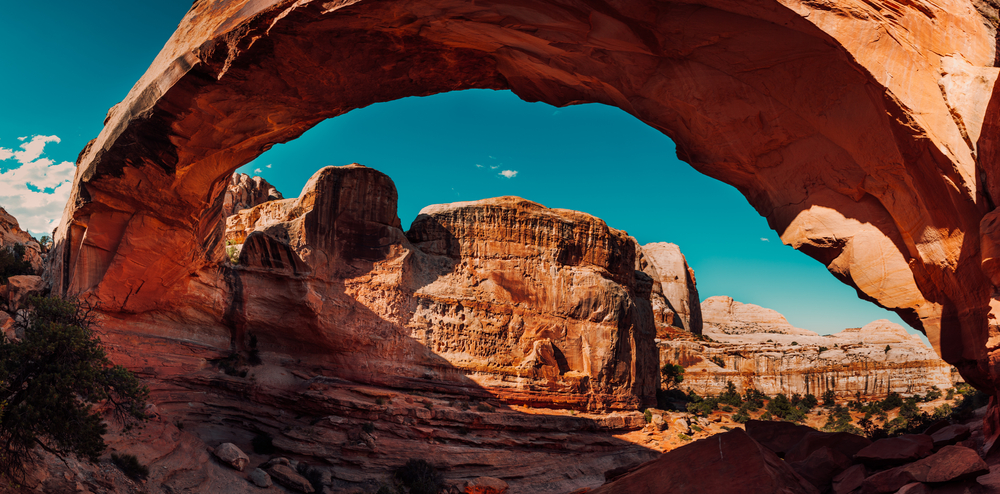
It could be said that Capitol Reef National Park is the most underrated of Utah’s incredible bounty of national parks. For some reason it doesn’t attract the attention that the remainder of the ‘Big Five’ do. Canyonlands, Arches, Bryce and Zion statistically receive more visitors, probably due to their proximity to each other or easy access from nearby towns. However, a park that’s brimming with stunning scenery, but attracts a fraction of the crowds, is undoubtedly worth making tracks to – even if there’s a little more driving to do.
Surrounded by dramatic red rocks and emerald meadows, Torrey is known as the gateway to Capitol Reef and is about eight miles away from the national park. Before hitting the trails, you can stock up with snacks and drinks at the historic Chuckwagon General Store on Main Street. There are a variety of lodging options from motels and resorts to yurts and teepees, and several excellent dining options which provide sustenance after a day exploring the park.

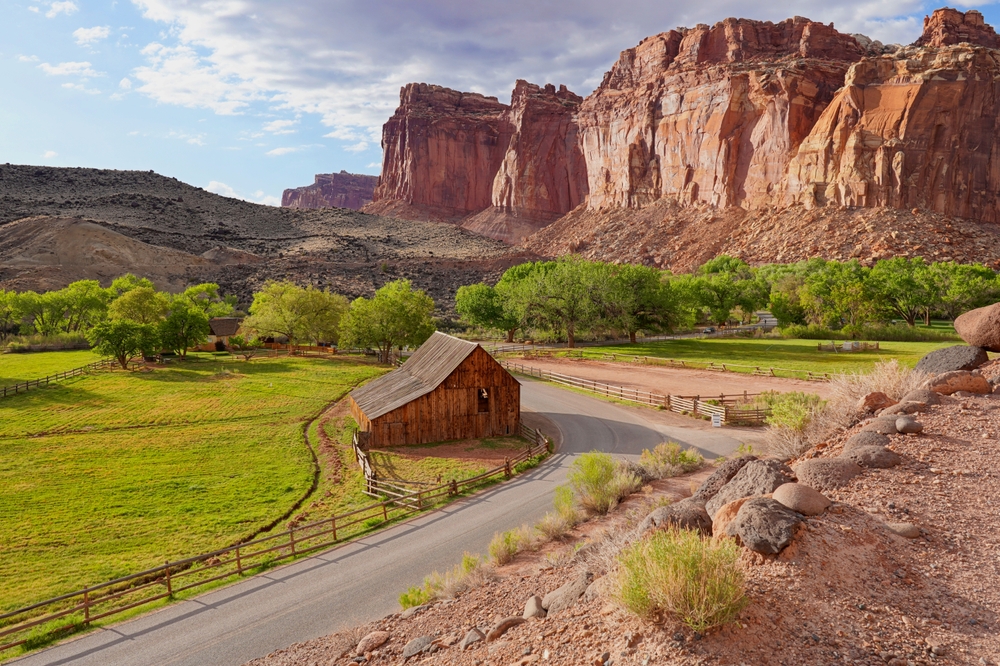
The park is formed by a so-called water pocket, a fold or wrinkle in the earth’s crust which encompasses an area of sixty miles by six miles. Within the park, there are canyons, arches, pillars and mesas galore. In other words, it’s nature on steroids, with a few interesting historical sites thrown in for good measure. You don’t even have to officially enter the park to experience much of its splendour. State Highway 24, also known as the scenic byway, runs straight through the park. From the road, which also forms a section of the route from Bryce to Moab, there are abundant views of castle-like mesas and soaring pillars.
Besides the eye-catching views along this stretch, there are several roadside attractions that are worth a stop. To take a step back in time, have a peek at the old schoolhouse. Dating back to 1896 and built by settlers, the one-room log cabin was also used as a community meeting place as late as 1924. The school was restored in the 1960’s and rows of desks and a blackboard can be seen inside. Press a button on the talking box situated outside the building and listen to Janice Oldroyd Torgorson talk about her experience of teaching at the school back in 1934.
A mile or so away from the school, a short boardwalk trail leads the way to petroglyphs at the base of a rockface. Created by the Fremont and Ancient Puebloan people who farmed in the area from approximately 600 to 1300 CE, there are images of human figures, bighorn sheep, deer and rabbits. Some of them are difficult to spot initially, but it’s worth spending a little time seeking them out.


If you want to take a hike without officially entering the park, the 1.8-mile Hickman Bridge Trail, also on Highway 24, follows the Fremont River and continues to an impressive sandstone arch. It’s a varied trail with a wealth of cool rock formations and scenic vistas. Watch out for Desert Bighorn Sheep, which can often be spotted close to the trail.
For those who want to infiltrate the park further, it’s worth exploring the eight-mile-long scenic paved road just beyond the visitor’s center. Before setting off, check out the village of Fruita, which was established back in the 1880’s by Mormon pioneers. A green oasis situated amongst the towering red rocks, there’s an orchard where apricots, pears and apples are still harvested. On the other side of the road at Gifford House, fruit pies, homemade ice cream and souvenirs are sold in the house where the Gifford family lived until 1969. An adjacent picnic area is an ideal spot to enjoy a bite to eat before hitting the road again.
The scenic road that winds its way through the park is full of spectacular sights from sheer sandstone cliffs to red rock canyons. There are numerous turn outs where you can stop the car and enjoy a few minutes taking in the magnificence of the scenery. Two dirt spur roads lead to trailheads. Grand Wash is an easy 4.5-mile hike surrounded by slot canyons and intriguing rock formations. For those who prefer a shorter hike, Capitol Gorge is a 2-mile round trip stroll through a canyon with walls etched with petroglyphs. Many naturally formed potholes can also be seen as you trek deeper into the gorge. Cassidy Arch Trail, named after the iconic outlaw Butch Cassidy, is reputably the area where he and his gang hid out back in the day. It’s a mildly challenging 3.5-mile hike with a little scrambling involved, but worth the effort for the views at the summit.


If you like to get off the beaten track, the rugged 60-mile-long Cathedral Valley Loop in the north of the park is an exciting adventure into a vast expanse of desert. With sweeping views of the multi-colored Bentonite Hills and massive red rock monoliths, it’s a beautiful spectacle. Only possible with a high clearance 4×4, few people venture this way, making it an appealing undertaking for anyone who enjoys a truly remote experience.
After a day of exploration, head to either Sunset Point or nearby Goosenecks Overlook. As the sun sinks, cast your eyes east and take in the changing light and sublime sight of the illuminated red rocks. A perfect end to a day in Capitol Reef National Park, Utah’s lesser known gem.