


In the swirling dust of the 1960s, thousands of young Westerners set out on a journey eastward, carving out paths that would come to be known collectively as the Hippie Trail. This loosely defined network of overland routes stretched from Europe to India, Nepal, and beyond, becoming a symbol of spiritual quest, self-discovery, and cultural exchange. The Hippy Trail was not just a physical path, but a journey of mind and spirit, one that drew on the freedom-loving ethos of its age and the thirst for meaning that marked a generation.
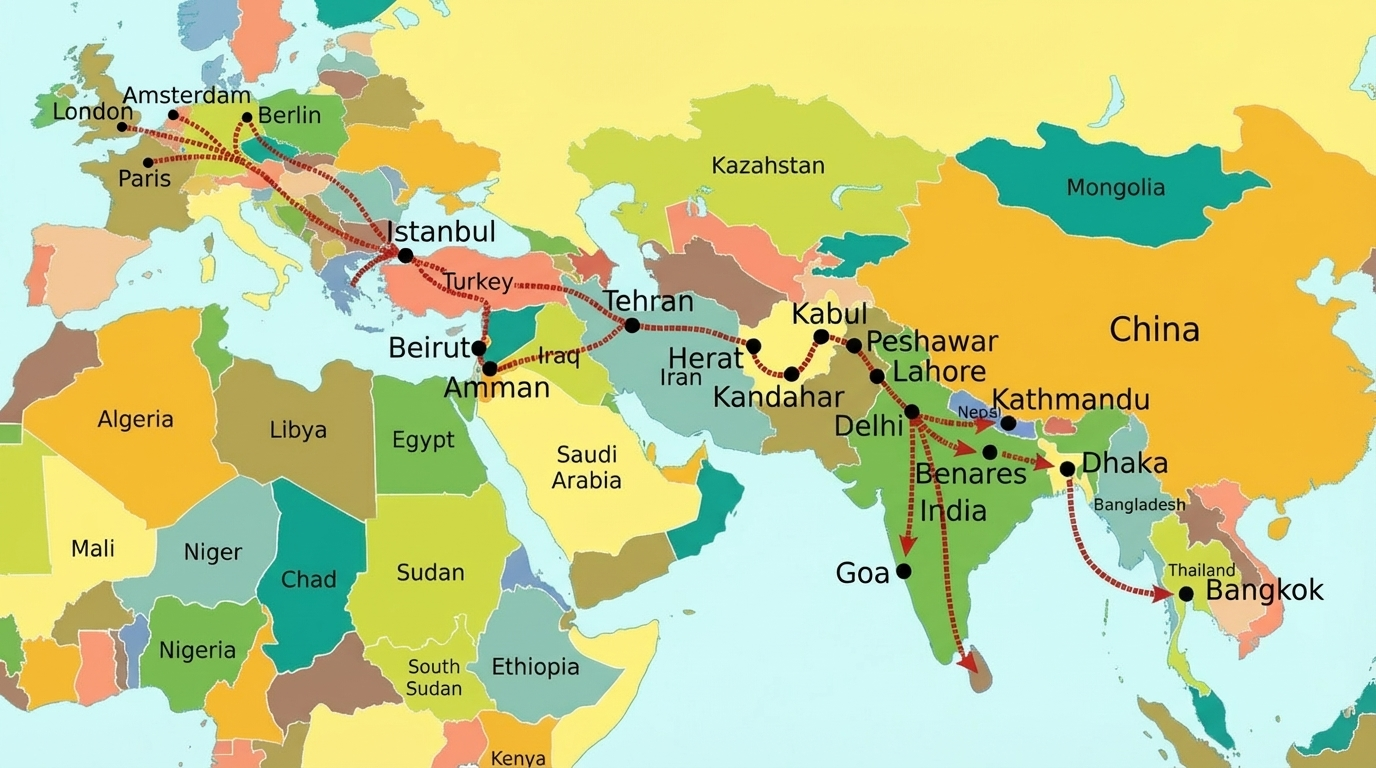
The Hippie Trail was not a single fixed path—it was a web of possibilities, knit together by word-of-mouth, guidebooks, and travelers’ tales. Most journeys began in cities like London, Amsterdam, or Istanbul, then headed east through lands both ancient and new. At its core, the Hippy Trail encapsulated a rebellion against the rigidity of Western society. It was more than an adventurous backpacking route; it was a rolling social experiment where individuals sought to transcend political boundaries and personal limitations. Participants came from varied walks of life—students, artists, wanderers, and dreamers—each driven by a common desire to explore radically different cultures, to find mystical enlightenment, alternative lifestyles, or simply to escape.
The Hippie Trail remains firmly fixed in the restless era of the 1960s and 1970s, defined by social upheaval: the civil rights movement, anti-war protests, the sexual revolution, and a blossoming consciousness that questioned authority and convention. In this climate, the Trail emerged both as an alternative to Western materialism and as a bridge connecting counterculture communities across the globe.
Across the U.S. and Western Europe, students marched against the Vietnam War, civil rights leaders called for racial justice, and musicians wrote anthems of peace and freedom. Against this backdrop, Eastern philosophy, mysticism, and psychedelic experimentation filtered into public consciousness. Literary icons like Jack Kerouac and Allen Ginsberg romanticized the open road; bands like The Beatles and The Doors drew inspiration from Indian music and spirituality. These influences provided a roadmap and an inspiration for the burgeoning movement of Western travelers seeking something beyond the everyday. The Beatles’ pilgrimage to Rishikesh to study with Maharishi Mahesh Yogi in 1968 amplified a wave of interest in meditation, yoga, and transcendental consciousness.
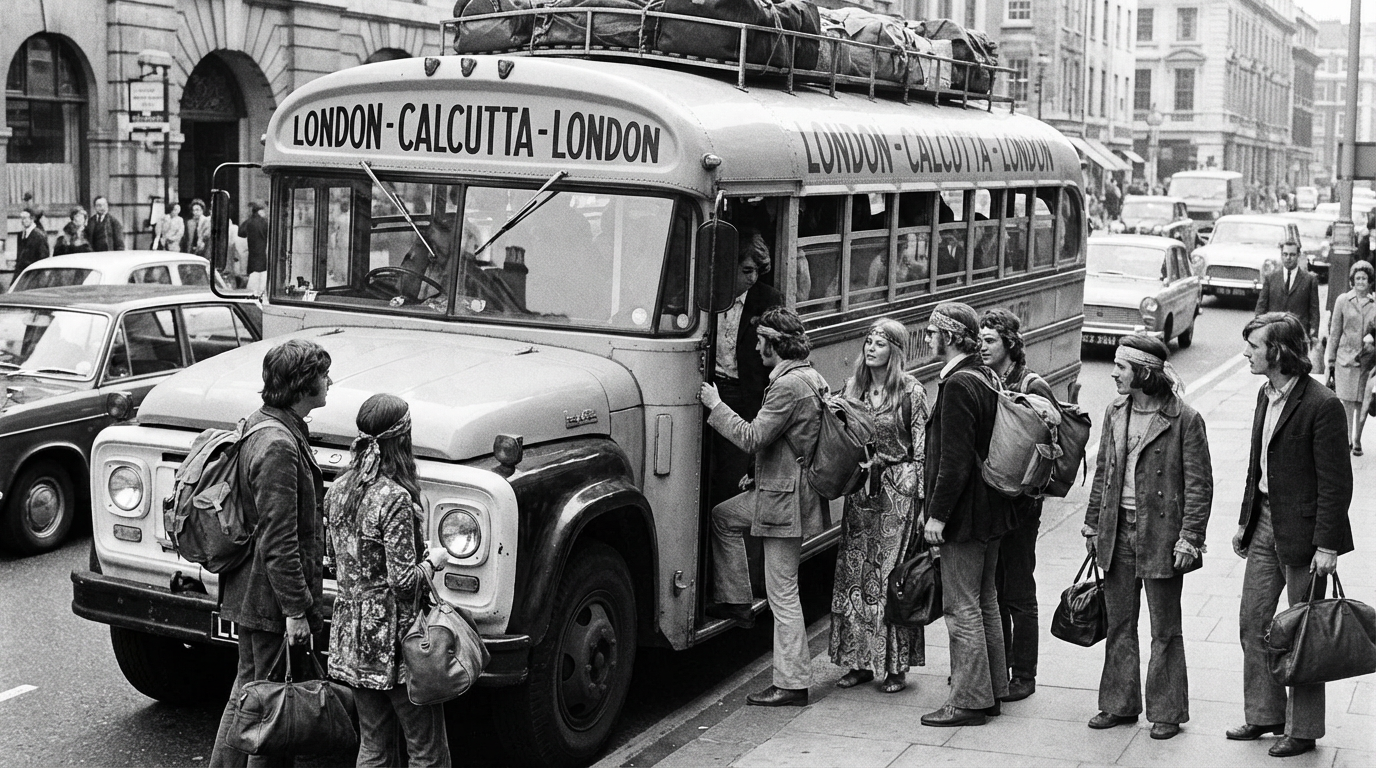
The most travelled routes crossed Turkey, Iran, Afghanistan, Pakistan, and Northern India, often culminating in Nepal or sometimes extending all the way to Southeast Asia. Buses, trains, and, for the adventurous, hitchhiking and shared vans, carried backpackers over borders and into the unknown. The process itself required flexibility, courage, and a profound willingness to be transformed by what lay ahead. Each country shaped the journey. In Turkey, travelers lingered in Istanbul’s hostels and bazaars; in Iran, they marveled at Persepolis and desert wonders; in Afghanistan, the legendary Hashish Trail drew many to Kabul, famed for its free-spirited vibe. In India, the sacred city of Varanasi and the beaches of Goa welcomed seekers and artists alike. The Annapurna foothills of Nepal marked the journey’s spiritual zenith for many, with mystical Kathmandu reveling in its reputation as the Trail’s end-of-the-road haven.
The influx of Westerners brought new income and opportunity. Local entrepreneurs opened guesthouses, cafes, and music clubs tailored to foreign tastes. Artisans found new markets for carpets, jewelry, and crafts, while spiritual teachers, musicians, and guides welcomed eager students. In return, many locals gained a window into Western counterculture, music, and politics, sparking both inspiration and, at times, conflict. Cultural misunderstandings and clashes over dress, behavior, and expectations were inevitable, and governments sometimes grew wary of the Trail’s influence. Adventures on the Hippy Trail were rarely without risk. Political volatility, border closures, and local unrest could interrupt even the most well-planned trips. Stories abound of border checkpoints demanding bribes, sudden changes in visa rules, or outright refusals of entry. In some countries, open use of marijuana or other drugs—so common in hippy enclaves—meant trouble with local authorities.
The echoes of the Hippie Trail can still be felt in the way we travel today. Backpacker hostels, adventure travel, slow travel, and the idea of journeys as tools for personal transformation all owe a debt to those who first struck out along the dusty roads from Europe to the subcontinent. Lonely Planet, now synonymous with independent travel, was started by a couple inspired by their own overland trip—a direct descendant of the Hippy Trail’s spirit. The Hippy Trail still reminds us that sometimes the best journeys take place off the well-trodden path
“Not all that wander are lost” ~ J.R.R. Tolkien