

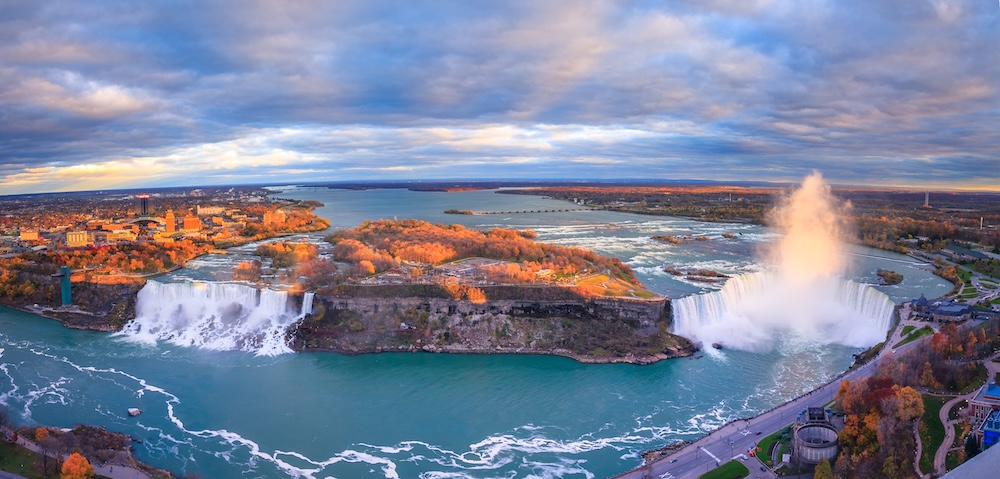
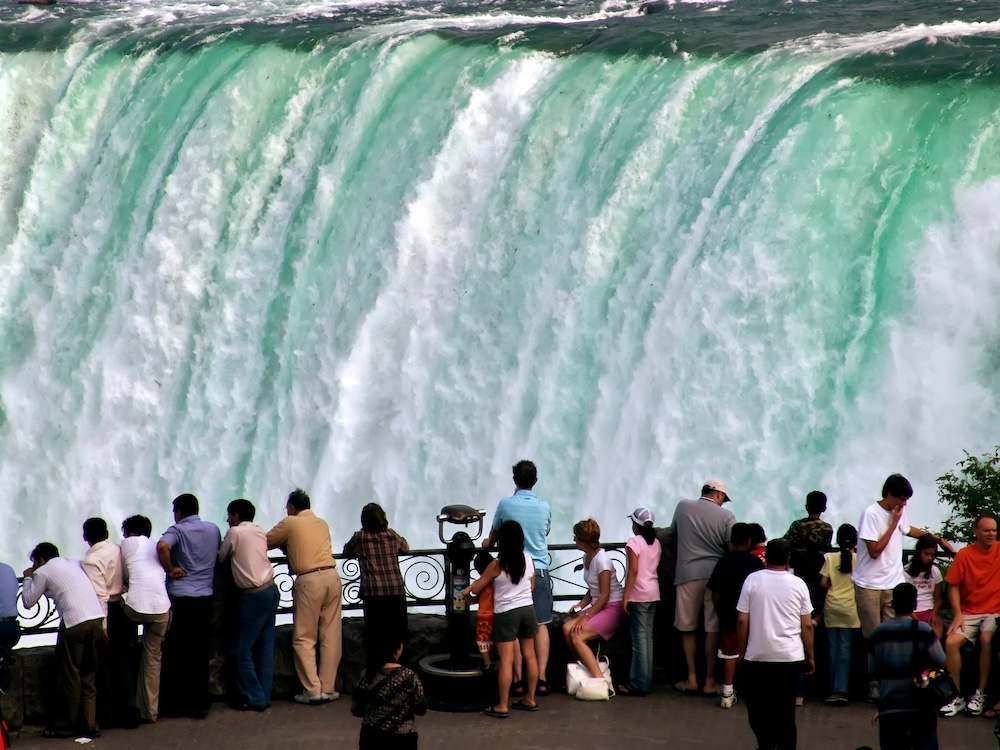
A woman in a blue plastic poncho is screaming with delight eleven feet from a curtain of water falling fifty-seven meters onto rock, and nobody around her finds this strange. This is Table Rock, on the Canadian side, where the mist comes up off Horseshoe Falls in cold gusts strong enough to soak you through a poncho that was, until about ninety seconds ago, doing its job. Somewhere behind her, a busker plays “Can’t Help Falling in Love” on a ukulele for tips, which is either the most on-the-nose song choice in North America or proof that Niagara Falls has been performing its own greatest hits for so long it no longer notices the irony.
Twelve thousand years ago, none of this existed as a tourist experience, mostly because there were no tourists, only retreating glaciers dumping meltwater into a river with nowhere graceful to go. That water found the edge of the Niagara Escarpment near present-day Lewiston and simply fell off it. The falls have been eating their way upstream ever since, roughly seven miles over the millennia, undercutting soft shale beneath a harder dolostone cap until slabs the size of buildings let go and crash into the gorge below. It is, geologically speaking, a very slow-motion collapse that people have decided to vacation next to.
Indigenous nations, principally the Haudenosaunee, knew the falls for centuries before Europeans arrived. French missionary Louis Hennepin recorded seeing them in 1678, and his account, generously exaggerated, made Niagara famous in Europe before most Europeans had any hope of visiting. It took another century and a half — the opening of the Erie Canal in 1825, then railroads pushing north from New York City and Toronto — before ordinary people could get here without weeks of overland misery. When they arrived, they found the brink of the falls lined with hucksters: fences built to charge admission for a view of a public river, mills and factories crowding the gorge, barkers hawking Native crafts of dubious authenticity. It got bad enough that a “Free Niagara” movement, backed by artists and writers who found the commercial clutter genuinely offensive, pushed New York State to reclaim the shoreline. In 1885, Niagara Falls State Park opened as the first state park in the country, landscaped by Frederick Law Olmsted, the same man responsible for Central Park. Ontario created its own protected parkland the same year. The falls, in other words, had to be saved from tourism, a pattern that anyone walking Clifton Hill today might recognize as unfinished business.
Here is a fact that surprises people who’ve never checked: Niagara isn’t tall. Roughly five hundred waterfalls on Earth are taller, including Angel Falls in Venezuela at nearly 3,200 feet against Niagara’s 188. What Niagara has instead is volume, more than 168,000 cubic feet of water per minute pouring over the crestline during peak season, more than any other falls in North America. Victoria Falls in Zambia claims the title of largest single sheet of falling water; Iguazu, straddling Argentina and Brazil, is wider and arguably more dramatic, a horseshoe of nearly 275 individual cascades. Niagara’s fame was never really about superlatives. It was about proximity, a genuine natural spectacle sitting an hour from a major rail line, then a highway, then two international airports, in a country that was inventing mass tourism at the same moment it was inventing mass transportation.
The honeymoon reputation predates all of that infrastructure. Theodosia Burr, daughter of Vice President Aaron Burr, toured the falls with her new husband in 1801, and where a Burr went, society followed. Napoleon’s younger brother Jérôme Bonaparte reportedly made the pilgrimage from New Orleans by stagecoach not long after, dragging his own bride toward the same spectacle for reasons that had less to do with waterfalls than with being seen at the correct waterfall. For decades the trip stayed a rich person’s indulgence. The Erie Canal and the railroads that followed changed the economics, and by the mid-1800s hotels on both sides were marketing directly to newlyweds, a habit the region never really broke.
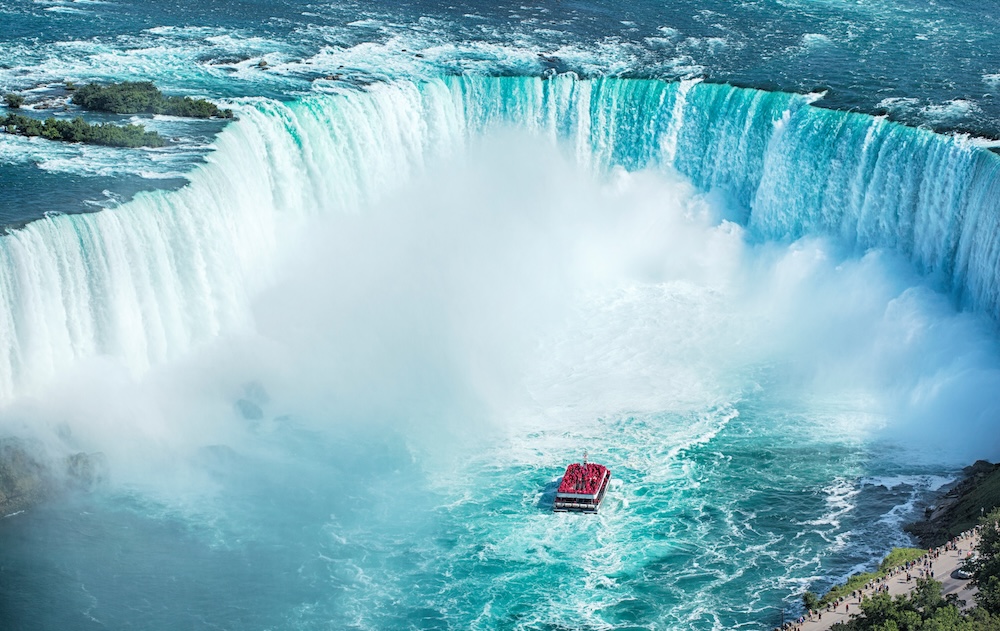
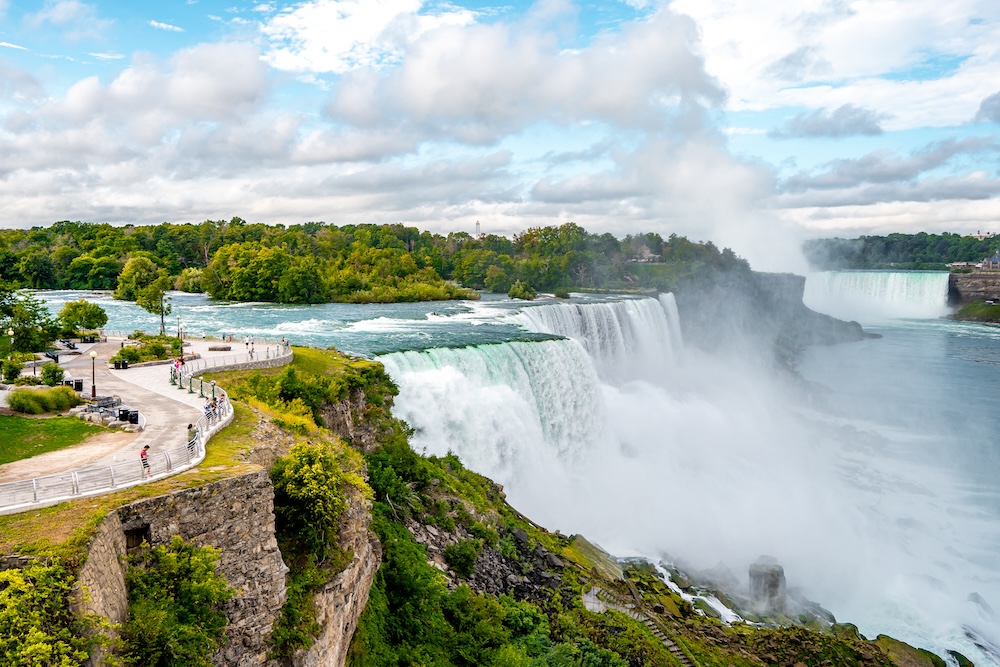
The border runs straight through the middle of the experience, and the two sides have grown into distinct personalities. The Canadian side gets the better view: you’re looking across at the American and Bridal Veil Falls while standing almost on top of Horseshoe Falls, and the panorama from Queen Victoria Park is the postcard shot everyone actually takes. Ontario has also built an entire entertainment district around that view: Clifton Hill’s wax museums and haunted houses, a casino resort, a Ferris wheel called the SkyWheel, high-rise hotels stacked with balconies angled at the falls, restaurants that charge accordingly. It is loud and unapologetically commercial, closer in spirit to a boardwalk than a park. The American side, by contrast, is quieter and greener, still largely Olmsted’s design: Niagara Falls State Park wraps around Goat Island, close-up encounters like Cave of the Winds put you at the base of Bridal Veil Falls, getting drenched on a wooden staircase, and the town itself has never rebuilt the density Ontario has across the river. Prices run lower. So does the energy. Most visitors eventually do both, crossing the Rainbow Bridge on foot with a passport, because the honest answer to “which side is better” is that they’re not really competing for the same thing.
Then there’s the falls’ other reputation, the one nobody puts on a honeymoon brochure. People have gone over Niagara Falls, on purpose, since 1901, when a sixty-three-year-old former teacher named Annie Edson Taylor sealed herself in a padded oak barrel to secure her financial future and emerged from the plunge pool bruised but alive, the first person to survive the drop. Others followed: Bobby Leach in 1911, Jean Lussier in a rubber ball in 1928, a rotating cast of daredevils through the twentieth century using barrels, capsules, and in a few documented cases nothing at all, including seven-year-old Roger Woodward, swept over in 1960 after a boating accident and pulled from the water below by the crew of the Maid of the Mist. Roughly a dozen and a half people have gone over the brink and lived to describe it, against a far larger, far grimmer number who did not survive the river’s rapids upstream, whether by accident or intent. Attempting the stunt today is a criminal offense on both sides of the border, which has done little to fully extinguish the tradition of people deciding they can beat physics.
Most visitors, sensibly, stay for the view rather than the plunge. Fallsview Boulevard on the Canadian side is lined with hotel towers competing on how many rooms face the water, the Sheraton, Marriott, and Hilton chains among them, the Fallsview Casino Resort anchoring the strip after dark. The American side offers fewer high-rises and correspondingly lower rates, along with the Red Coach Inn, a Tudor-style holdover from 1923 that predates most of the surrounding buildings. Couples wanting distance from both entertainment districts often base themselves twenty minutes north in Niagara-on-the-Lake, a preserved nineteenth-century town on Lake Ontario that has quietly become the region’s wine country, its bed-and-breakfasts surrounded by vineyards producing Ontario’s ice wine rather than casino chips.
Beyond the falls themselves, the region rewards a day or two of wandering: the Whirlpool Aero Car swinging over the rapids downstream, the Butterfly Conservatory, Old Fort Niagara at the river’s mouth where French, British, and American flags have each taken their turn, and more than a hundred wineries within a short drive for anyone who’d rather taste something than get soaked by it. But most people, however they arrive, end up back at the railing eventually, gripping a poncho that isn’t working, watching several centuries of hucksters, honeymooners, and lunatics in barrels collapse into one continuous roar.